KEYS TO STUNNING LOW LIGHT PHOTOGRAPHY
Whether you are taking photos at a concert, wedding or dance recital, nothing tests a camera and lens more than low light action photography. It is essential to use the right camera, lenses and settings to capture fast moving action in dim light without a flash. The key is to use a camera with a large sensor and wide aperture lenses. This combination allows you to capture the maximum amount of light available to reduce motion blur and noise in photos. The second key is to use the proper camera settings to freeze action and minimize noise in low light. This includes fast shutter speeds, wide apertures (f-stops), and the lowest possible ISO setting. We recommend the following settings to capture stunning low light action photography:
- shutter speeds higher than 1/125
- wide lens apertures from f/2.8 to f/1.2
- ISOs under 1600 (the lower the better)
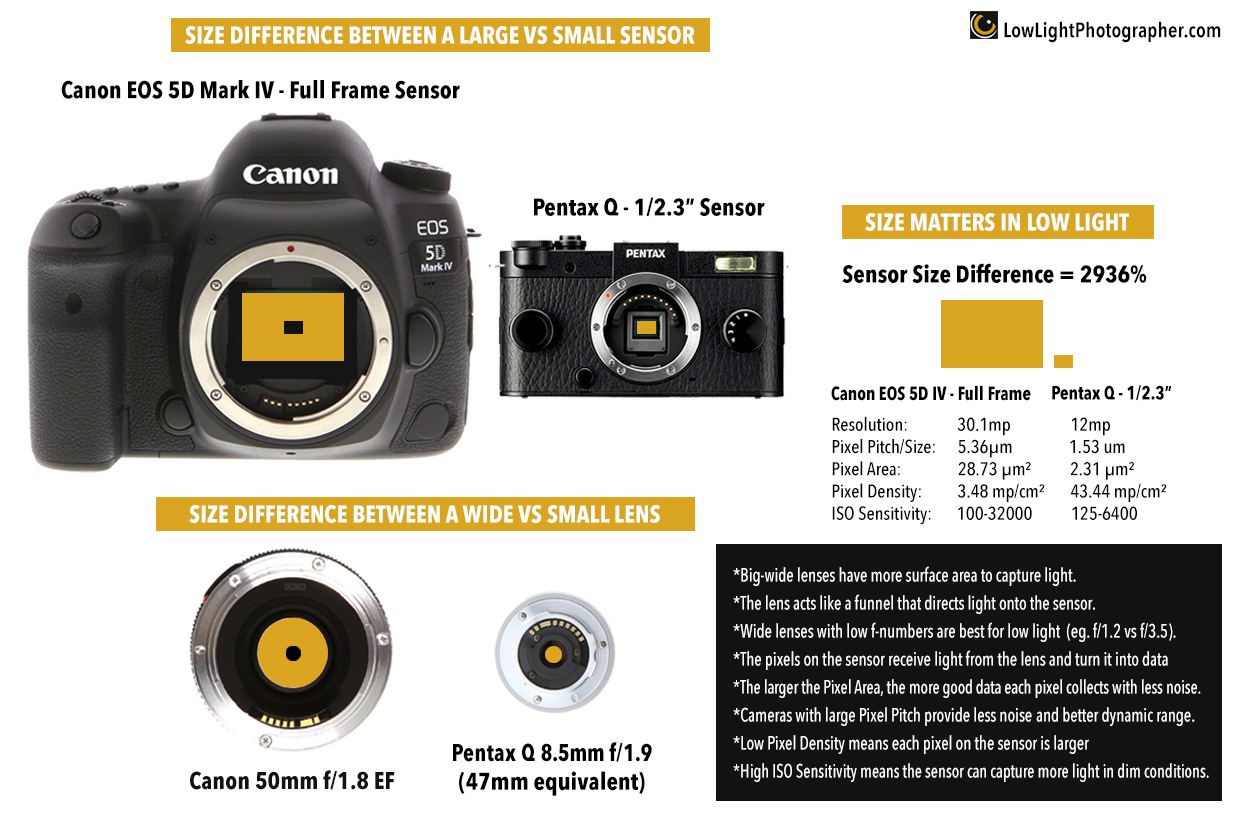
These settings are only possible with cameras that have large sensors and physically wide lenses. Size and settings matter in low light. The main difference between a compact camera and full frame camera is their low light performance due to the size difference between their sensors and lenses.
OUR RECOMMENDATIONS
Our recommendations are based on a number of factors that determine a camera’s low light performance. The best cameras for taking low light action photos have:
- an excellent selection of wide aperture lenses from f/1.2 to f/2.8
- the largest sensor possible that fits your needs and budget
- phase detect or hybrid auto focus systems that acquires focus in low light
- the ability to take clean photos at ISO 1600 to 8,000
- fast burst modes (FPS) for capturing action in low light
- bonus points for dual card slots and excellent battery life
- In Body Image Stabilization (IBIS) for reducing camera shake
- excellent video quality for videographers
BEST CANON MIRRORLESS CAMERAS FOR LOW LIGHT
| Camera | Price | Mega Pixels | Pixel Pitch | Pixel Area | Pixel Density | ISO | AF Points | AF Sensitivity | FPS | Shutter Speed | IBIS | Video |
|---|---|---|---|---|---|---|---|---|---|---|---|---|
| Canon EOS RP | BUY | 26MP | 5.73 | 32.83 | 3.05 | 100-40,000 | 4,779 | EV -5^^ | 5fps | 1/4000 sec | No | 4K |
| Canon EOS R | BUY | 30MP | 5.34 | 28.52 | 3.51 | 100-40,000 | 5,655 | EV -6^ | 8fps | 1/8000 sec | No | 4K |
LOW LIGHT CAMERA CRITERIA
Sensor Size: Cameras with “Full Frame” sensors are the top choice for capturing low light photos due to the large size of their sensors. However, cameras with smaller sensors like APS-C and Micro Four Thirds cameras can also capture low light photos when paired with wide aperture lenses. For APS-C cameras, we recommend buying lenses with apertures from f/1.2 to f/2.8. For MFT cameras, we recommend buying lenses with apertures from f/0.95 to f/1.4.*
*Be aware opening a lens to its widest aperture (f-number) decreases the depth of field which makes it much harder to focus on moving subjects in low light. The benefit of full frame cameras is they allow you to use higher f-stops to increase the depth of field which improves the ability to focus.
Pixel Pitch is the distance from the center of one pixel (photosite) to the center of the next pixel measured in µm.
Pixel Area is the size of the photosite measured in µm². Larger photosites capture more light and information. However, large photosites take up more space on the sensor which lowers the number of megapixels and resolution of photos. Although having more megapixels is useful when you need to crop and enlarge photos, .
Pixel Density is how many million of pixels fit in one square centimeter of the sensor measured in MP/cm². Smaller sensors that cram more pixels together have poorer low-light performance and produce noisier photos.
ISO
AF Points (Auto Focus Points): In most cases, DSLRs outperform mirrorless cameras for capturing fast action in low light due to their phase detection autofocus systems. However, mirrorless cameras with hybrid autofocus systems (that combine phase and contrast auto focus points).
In low light, AF performance drops regardless of system, since the sensors have less light and contrast to work with.
Canon’s Dual Pixel AF system is very different in that the majority of the actual photosites on the sensor function in a dual role: they can measure both phase info and luminance, even at the same time. This is especially useful when shooting video.
AF Sensitivity refers to a cameras ability to autofocus in low light. A camera with an EV value of -3 to -6 is capable of focusing under moonlight and darker.
Shutter Speed and FPS (Frames Per Second)
IBIS
VIDEO RESOLUTION